Austin, Texas
Voice Coach in Austin for Singers, Speakers, and Performers
If you are looking for a voice coach in Austin, you are looking for someone who can tell you exactly why your voice does what it does, and what to change first. Every lesson is one to one and built around your voice, not a generic curriculum.
- Private, one to one lessons for every age and level
- Singing, speaking, audition, and studio work
- In person across Greater Austin or online statewide
- Beginners genuinely welcome, no audition required
Book Your First Lesson
Tell us what you want to work on. We reply within one business day.
What we teach
Voice Coaching Services in Austin
Nine focused programs covering the singing voice and the speaking voice, for every age and level. Not sure which one fits? Start with private voice lessons and we will map a plan in the first session.
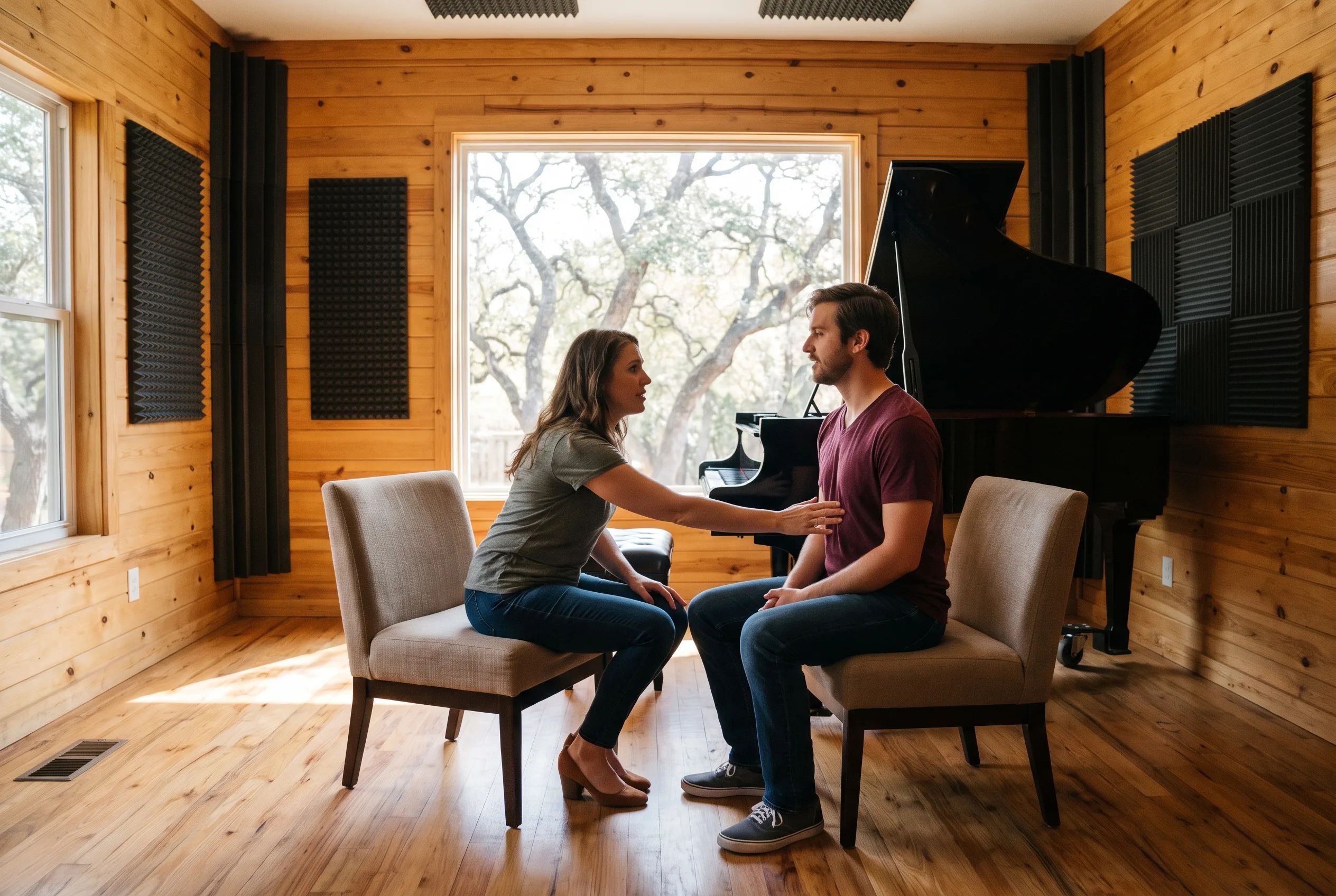
Private Voice Lessons
One to one training in breath, tone, range, and control, built around the voice you already have.
Learn more
Singing Lessons for Beginners
A patient starting point for adults and teens who have never had a lesson and want the fundamentals done right.
Learn more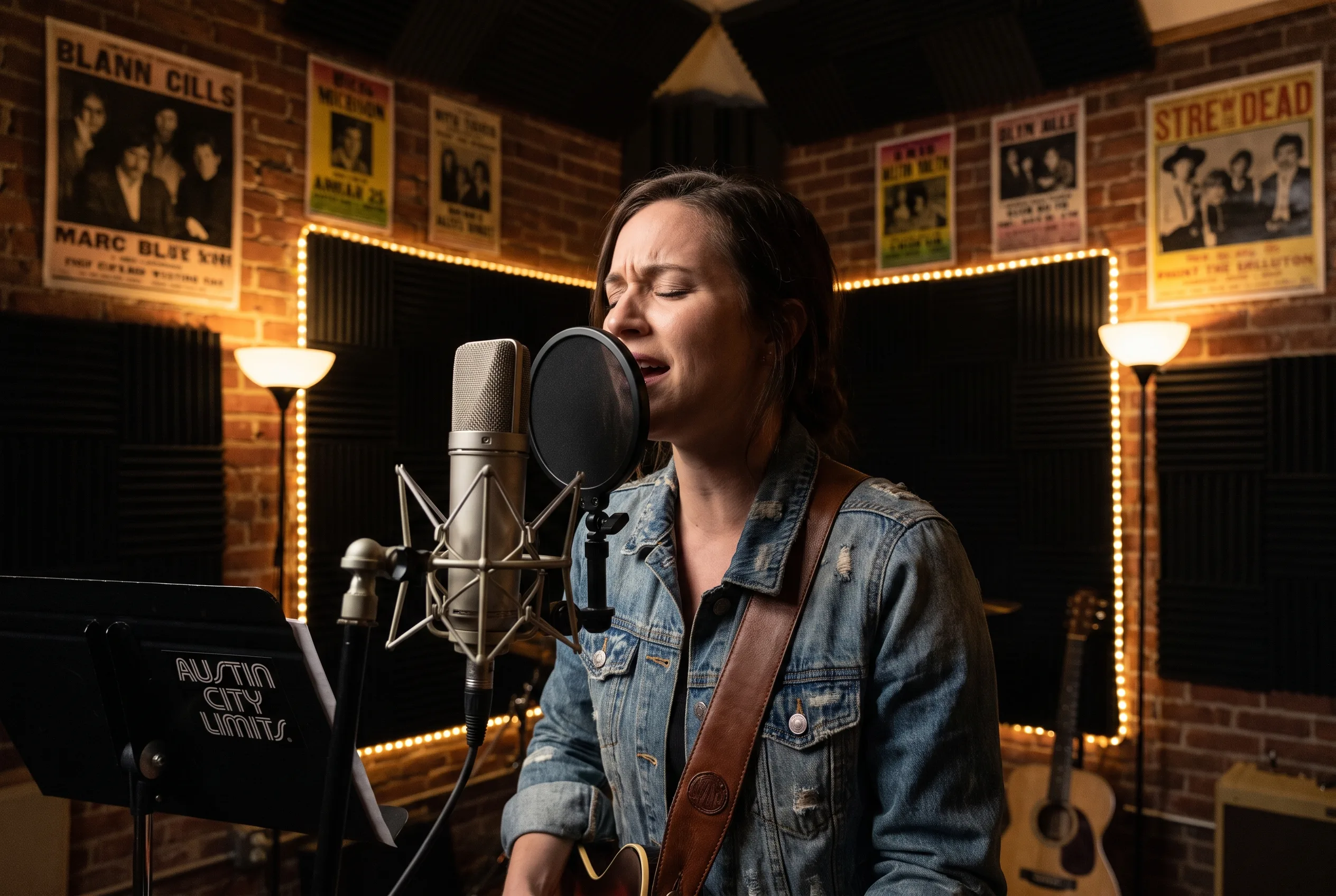
Vocal Coaching for Advanced Singers
Refinement for working singers: register transitions, stamina, stylistic control, and repertoire strategy.
Learn more
Kids and Teens Voice Lessons
Age appropriate technique that protects a developing voice while building confidence and musicianship.
Learn more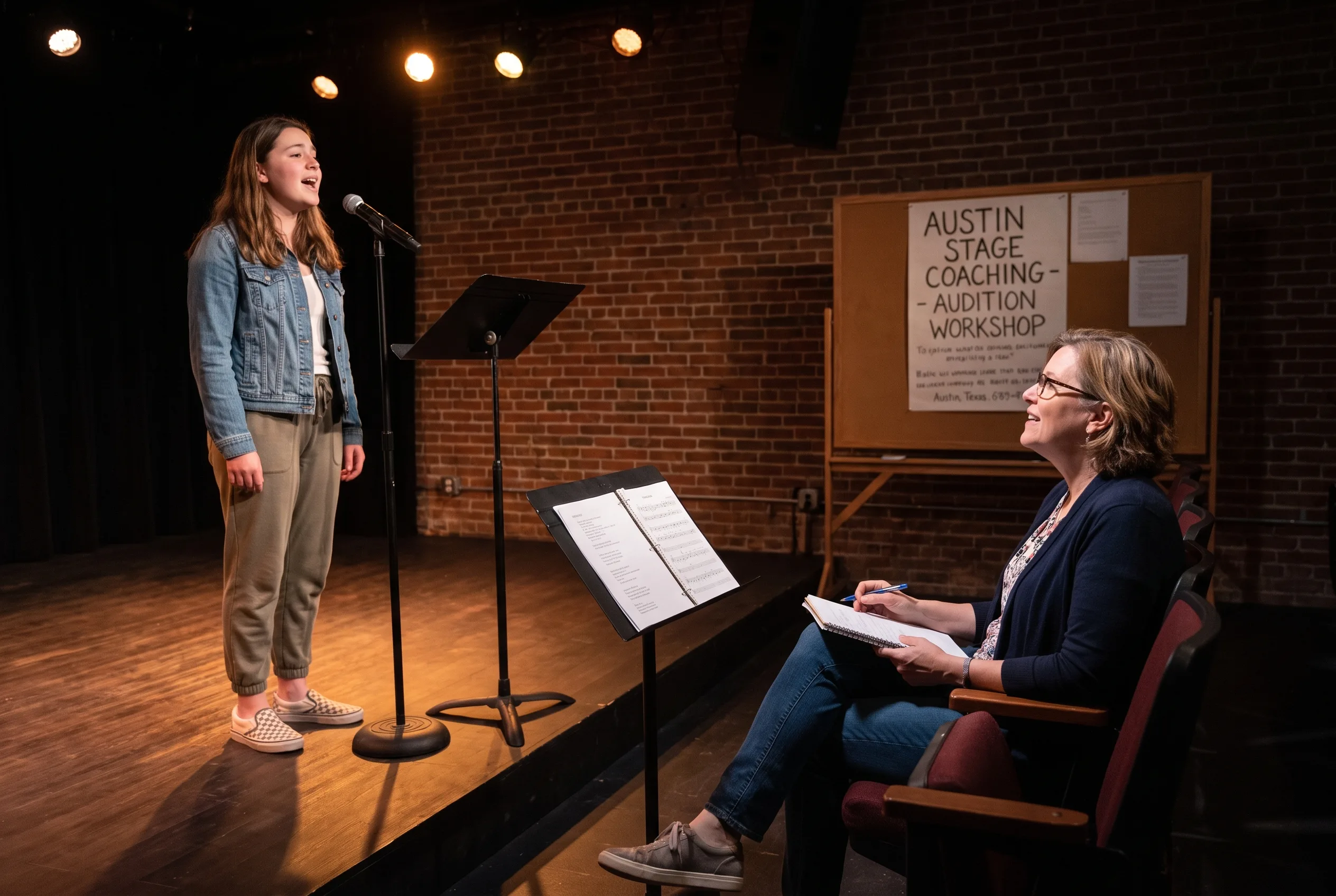
Audition Prep and Performance Coaching
Song selection, cuts, sixteen bar edits, and the nerves management that decides how the room hears you.
Learn more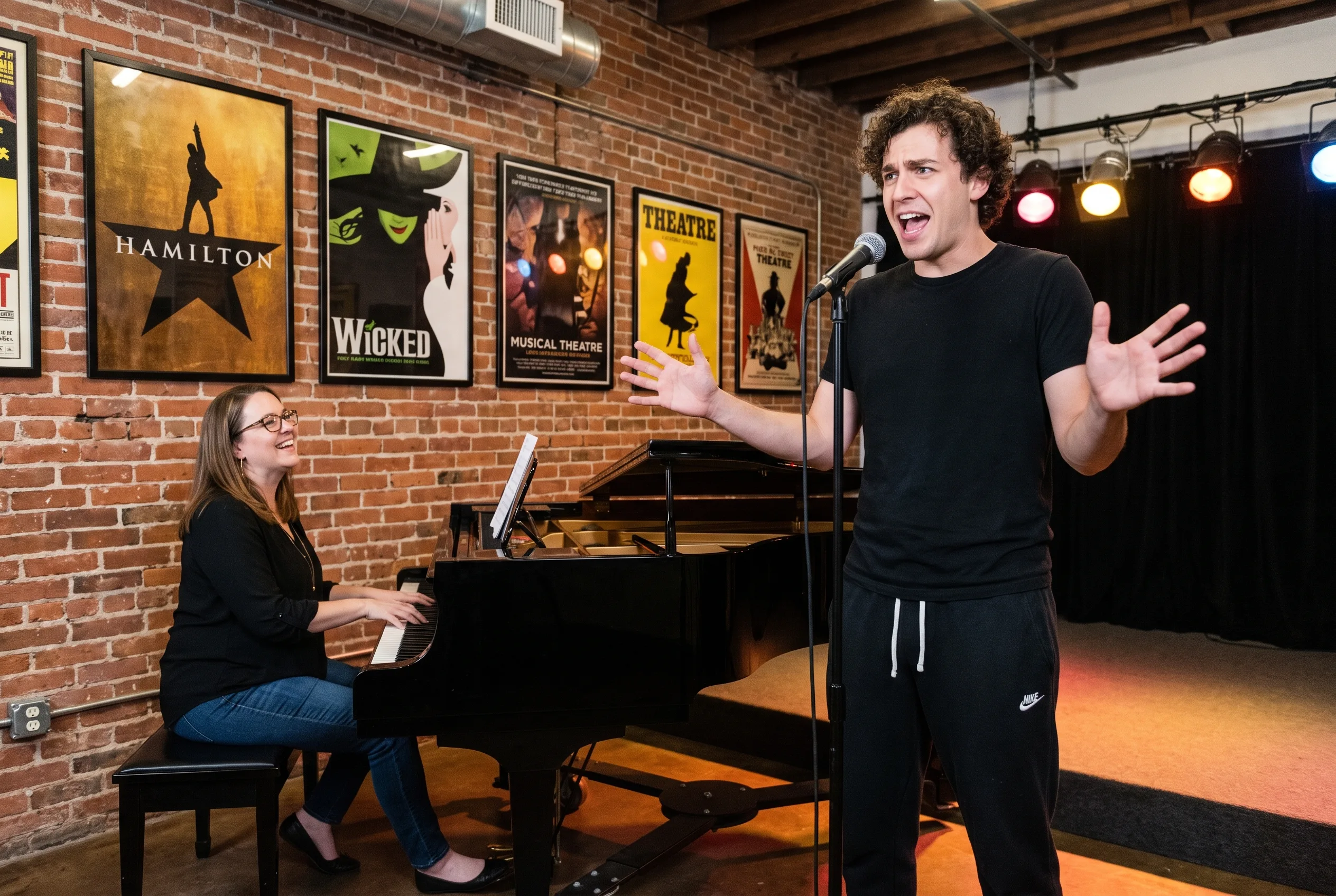
Musical Theatre Voice Coaching
Legit, belt, and mix for theatre repertoire, with acting through song treated as part of the technique.
Learn more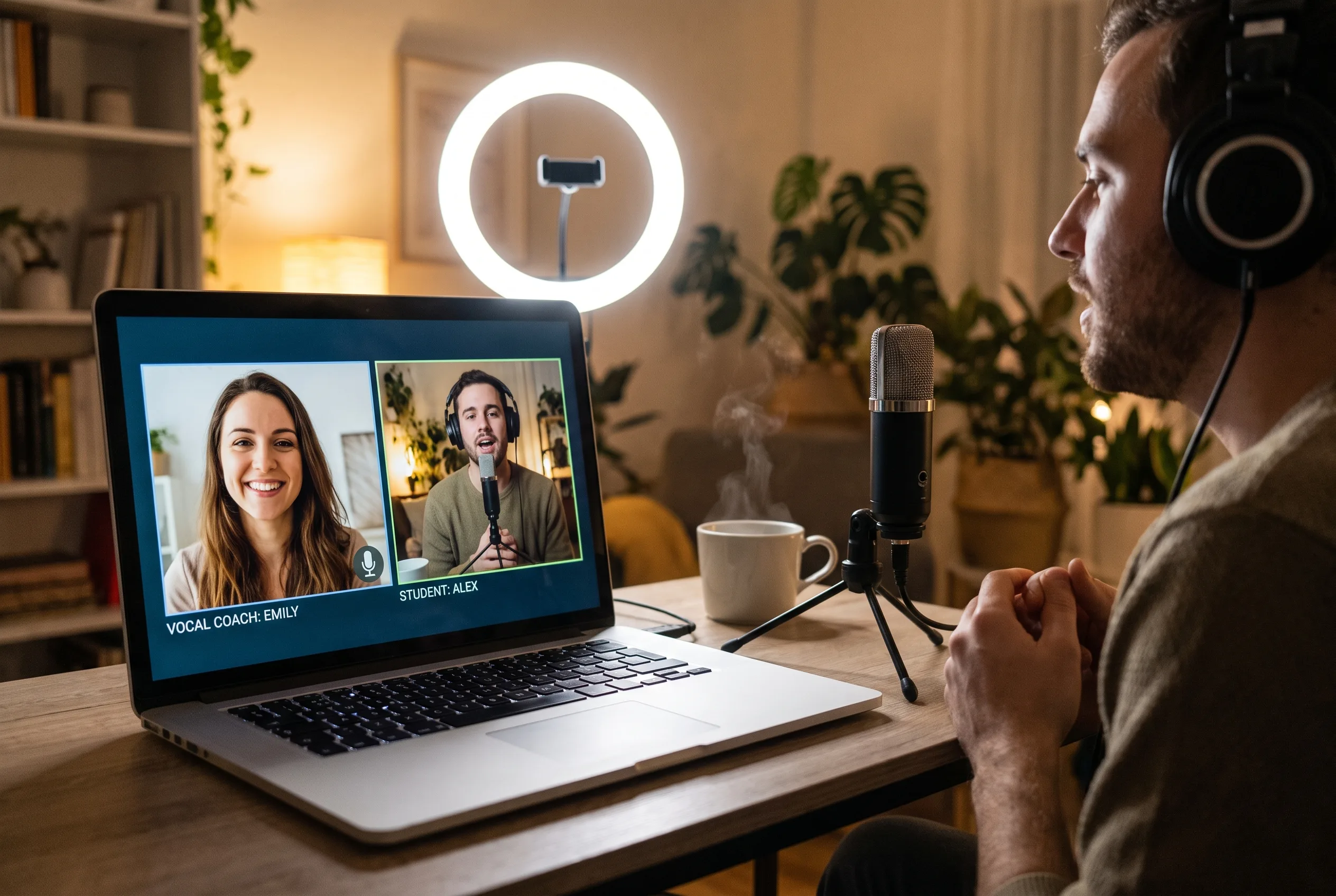
Online Voice Lessons
The same structured technique work by video for students anywhere in Texas, with a setup guide that actually works.
Learn more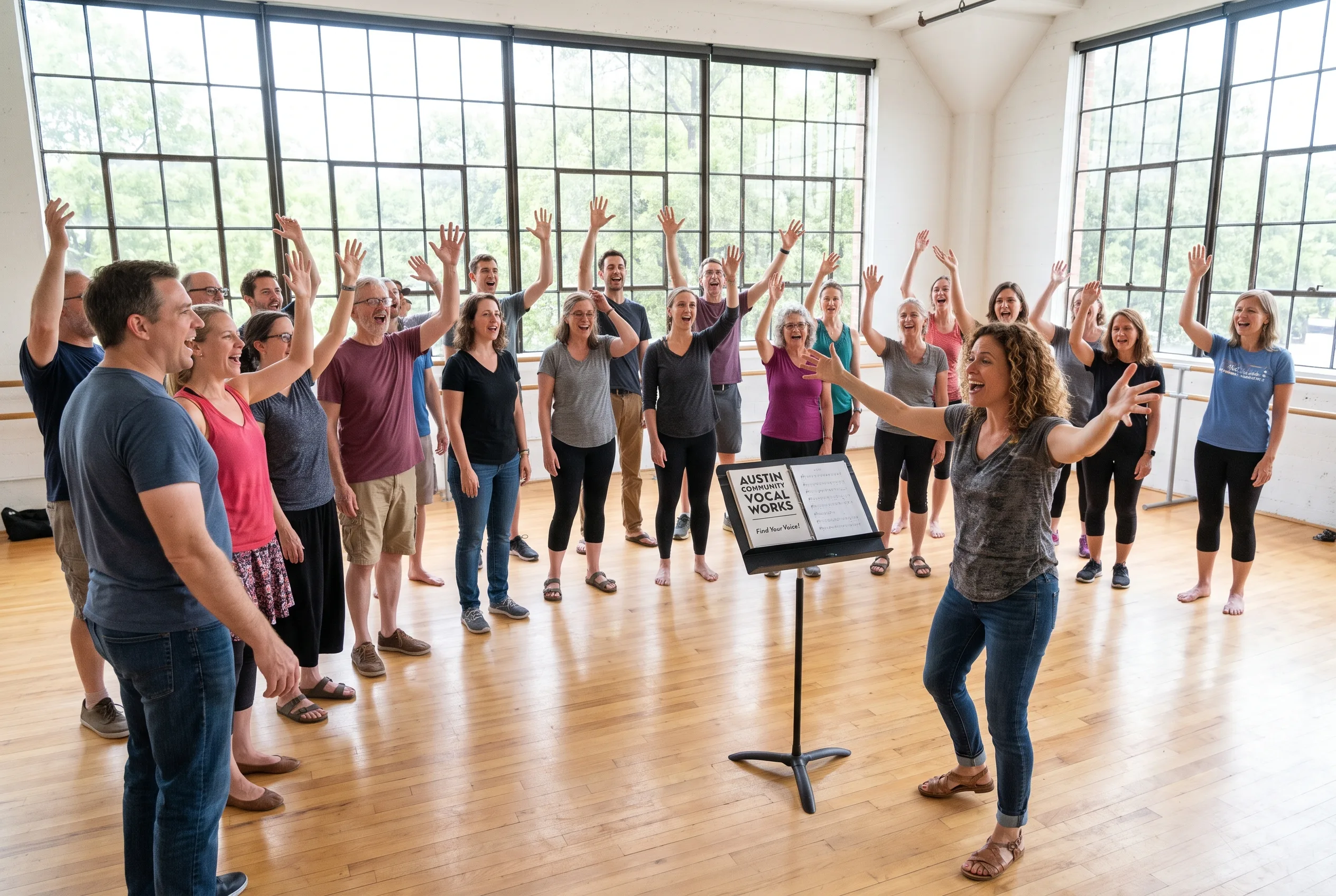
Group Singing Classes and Workshops
Low pressure group sessions and one off workshops for harmony, ear training, and performance practice.
Learn more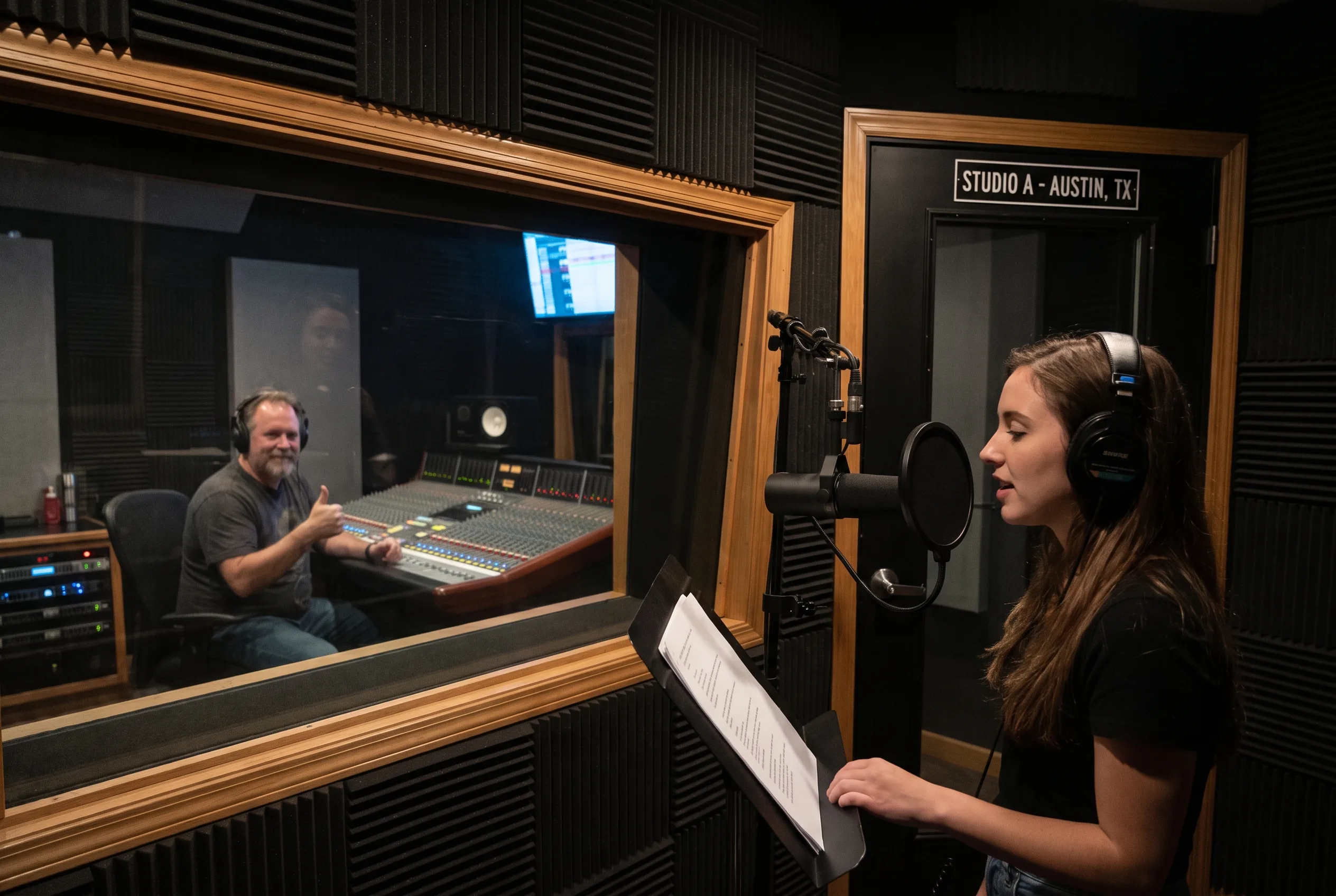
Voiceover and Broadcast Voice Coaching
Microphone technique, read styles, and vocal endurance for voice actors, podcasters, and presenters.
Learn moreWhy students choose us
Why Austin Singers Choose Voice Coach Austin
Voice Science First, Not Folk Wisdom
Population research published in The Laryngoscope found roughly 30 percent of adults experience a voice disorder during their lifetime, and much of the damage traces back to advice that was never accurate. We teach from current voice science: how the vocal folds actually vibrate, what breath pressure does to tone, and why "sing from your diaphragm" is an incomplete instruction. You get explanations you can verify, not mystique.
Built for the Austin Music Economy
Austin has been the officially designated Live Music Capital of the World since the City Council adopted the title in 1991, and it hosts both South by Southwest and Austin City Limits. That shapes what local singers actually need: material that survives a loud room, stamina for multi set nights, and a voice that holds up across a festival week. Coaching here is built around those demands rather than a conservatory template.
Practice Plans You Can Repeat Alone
The NIDCD estimates about 7.5 million people in the United States have trouble using their voices, and unsupervised practice is where most people either recover or make things worse. Every lesson ends with a written plan naming the exercise, the reason for it, and the specific sensation to listen for. The goal is that six days without a coach still moves you forward instead of undoing the seventh.
Start this week
Book Your First Lesson and Get a Written Practice Plan
Every new student leaves the first session knowing what is limiting their voice and what to practise next. We reply to every enquiry within one business day.
Request a Lesson
Three fields, then we call you back.
Common problems
What Types of Voice Problems Do We Fix?
Most people arrive describing a symptom rather than a cause. These are the six patterns we see most often in Austin students, and what actually sits underneath each one.
Running Out of Range at the Top
The most common complaint is a ceiling: the voice works fine until a certain note, then thins out, cracks, or disappears. This is almost never a hard physical limit. It is usually a register transition being negotiated by squeezing rather than by rebalancing air pressure and vocal fold tension. Retraining the transition with graded exercises typically opens usable notes that were already available but defended against.
Vocal folds vibrate roughly 100 to 220 times per second in normal speech, and over 1,000 times per second at the top of a trained soprano rangeVocal Fatigue and Strain
If your voice is tired by mid afternoon, or hoarse after every gig, the problem is load management rather than weakness. Occupational voice users carry the highest risk. Research by Roy and colleagues found teachers reported a lifetime prevalence of voice problems of about 58 percent, roughly double the rate among non teachers. We reduce the effort per phrase first, then rebuild stamina on top of the more efficient technique.
Teachers report voice problems at roughly twice the lifetime rate of non teachers, per Roy et al.Pitch Accuracy and "I'm Tone Deaf"
Almost everyone who says they are tone deaf is not. Congenital amusia, the genuine clinical inability to process pitch relationships, affects only a small minority of people. The far more common situation is an untrained ear paired with an untrained set of muscles, so the singer hears the target but cannot yet steer the voice to it. Both halves respond to structured ear training and pitch matching work.
True congenital amusia affects an estimated 4 percent of the population, so the overwhelming majority of self described tone deaf singers are trainableBreath That Runs Out Mid Phrase
Running out of air is usually a leak, not a shortage. Most untrained singers take in plenty of breath and then waste it in the first two seconds through an inefficient vocal fold closure. Work here focuses on managing the exhale rather than inhaling more, which is why "take a bigger breath" so often fails as advice. Efficient closure lengthens phrases without any increase in lung capacity.
Trained singers commonly sustain comfortable phonation for 20 to 30 seconds, against roughly 10 to 15 seconds for untrained adultsPerformance Anxiety That Undoes the Technique
Plenty of singers who sound excellent in a lesson lose half their range on stage. The physiology is real: the stress response raises laryngeal tension, shortens the breath cycle, and dries the vocal folds, all of which directly degrade tone. Because the cause is physical as well as psychological, we treat it with rehearsal design and breath protocols rather than reassurance alone.
Performance anxiety is reported by a majority of professional musicians in survey research, making it one of the most common issues in the fieldThe Break Between Chest and Head Voice
That audible flip in the middle of the range is the passaggio, the zone where the vocal folds have to change how they vibrate. Left alone, singers develop a habit of either pushing chest voice too high or abandoning it too early. Neither is sustainable. Blending the registers into a coordinated mix is slow, deliberate work, and it is the single most requested technical fix among intermediate students.
The primary passaggio typically sits around E4 to F#4 for male voices and around A4 to C5 for female voicesSources: National Institute on Deafness and Other Communication Disorders (NIDCD); Roy N, Merrill RM, Gray SD, Smith EM, "Voice disorders in the general population," The Laryngoscope (2005); Roy N et al., "Prevalence of voice disorders in teachers and the general population" (2004). Frequency and passaggio ranges are standard voice pedagogy reference values and vary by individual.
How we work
What Types of Voice Coaching Services Do We Offer in Austin?
Six broad categories cover almost every reason someone books a voice coach in Austin. Each one maps to one or more of the nine programs above.
One to One Technical Training
The core offering. A single student, a single voice, and a diagnosis before any exercise gets prescribed. Group classes cannot do this, because the correction that unlocks one singer is actively wrong for the person next to them. A weekly private lesson paired with short daily practice is the format with the strongest track record across every style we teach, from country to classical to contemporary pop. This is where the majority of students spend their first year.
Distributed practice beats massed practice: short daily sessions consistently outperform one long weekly session in motor learning researchBeginner Foundations
For adults and teens starting from zero, the first weeks are about posture, breath, and removing jaw and tongue tension, not about repertoire. Beginners frequently make their fastest gains of all, because they have fewer entrenched compensations to unpick than singers who have been self teaching for a decade. No audition, no prior music reading, and no requirement to already have a "good voice" to begin. Nerves about the first lesson are normal and expected.
Most beginners report noticeable change in breath control and tone within four to six lessons, since early gains come from releasing tension rather than building strengthAdvanced and Professional Coaching
Working singers need something different from beginners: not new fundamentals, but marginal gains and damage control. Typical work covers smoothing register transitions under performance conditions, extending stamina across multi set nights, developing stylistic range so one singer can credibly cover several genres, and building a warm up that survives a real load in venue. For touring and gigging singers, vocal longevity is a career asset, and it is trainable.
Professional voice users are the highest risk occupational group for voice injury, which makes load management a technical skill rather than an afterthoughtYouth Voice Training
Children and adolescents need technique that respects a changing instrument. Structured lessons generally suit ages seven and up, once a child can hold focus for a half hour and follow instruction about breath and posture. Through adolescence, especially during the male voice change, the priority is protecting the voice and maintaining confidence rather than pushing range or volume. Repertoire is chosen to fit the voice as it currently is, not the voice it will become.
The adolescent male voice typically lowers by about one octave during the voice change, which is why repertoire has to be reassessed regularlyAudition and Performance Preparation
Deadline driven work with a different rhythm from open ended technique lessons. It covers song selection matched to the specific casting or opportunity, cuts and sixteen bar edits that land in the time available, the material that shows range without exposing weakness, and rehearsal designed to make the performance repeatable under pressure. Students preparing for a fixed date often move to twice weekly sessions in the final month before the audition.
Sixteen bar and thirty two bar cuts remain the standard audition formats in musical theatre, so edit choice is a technical decision in its own rightOnline Coaching Across Texas
Video lessons handle technique, repertoire, and audition prep effectively, and they remove the commute that causes most cancellations. The limiting factor is audio, not video: wired headphones, a stable connection, and a quiet room matter far more than an expensive microphone, and laptop speakers cause feedback that makes accurate diagnosis impossible. Every online student gets a short setup guide before the first session so lesson time is not spent troubleshooting.
Wired headphones remove the echo cancellation that video platforms otherwise apply, which is what makes accurate vocal diagnosis possible over a callStudent feedback
What Austin Students Say
Placeholder testimonial. Replace with a real student quote of 30 to 60 words describing the specific problem they arrived with and what changed.Student nameAustin, TX
Placeholder testimonial. Replace with a real student quote of 30 to 60 words, ideally from a different program than the other two.Student nameRound Rock, TX
Placeholder testimonial. Replace with a real student quote of 30 to 60 words, ideally mentioning a measurable outcome such as an audition result.Student nameCedar Park, TX
About
A Voice Coach Who Explains the Why
Voice Coach Austin exists because too many singers have been handed instructions without reasons. "Support more." "Open your throat." "Sing from your diaphragm." Each of those points at something real, and none of them tells you what to physically do. The result is a lot of students who practise hard for years and plateau anyway.
Lessons here start with diagnosis. Before any exercise is assigned, the first session establishes what your voice currently does, where it stops doing it, and which of the three usual suspects, breath, tension, or register coordination, is actually responsible. From there the exercises are chosen to address that specific cause, and you are told why each one is on your list.
Students range from complete beginners who have never sung outside a car to working Austin performers managing a gig schedule. The technique underneath is the same. What changes is the repertoire, the pace, and how much load the voice needs to carry.
Read more about our approach to voice coaching or get in touch to book a first lesson.
Service area
Voice Lessons Across the Greater Austin Area
In person lessons are available throughout Austin and the surrounding communities. Students outside these areas are welcome to book online voice lessons from anywhere in Texas.
Questions
Frequently Asked Questions About Voice Lessons in Austin
Do I need to be able to sing already to take voice lessons in Austin?
No. A large share of new students arrive having never had a lesson, and some are convinced they are tone deaf. True congenital amusia, the clinical inability to process pitch, affects only a small fraction of the population, so almost everyone who thinks they cannot sing is actually describing an untrained ear and an untrained set of muscles. Both respond to structured practice.
How long does it take to hear a difference in my voice?
Most students notice changes in breath control and tone within the first four to six lessons, because those early gains come from removing tension rather than building new strength. Range extension and stamina take longer, since they depend on conditioning the small muscles of the larynx, and that follows the same slow timeline as any other physical training.
Are voice lessons only for singers?
No. Teachers, attorneys, podcasters, clergy, sales professionals, and voice actors all train the speaking voice. Population research published in The Laryngoscope found that roughly 30 percent of adults experience a voice disorder at some point, and occupational voice users carry a much higher risk, so speaking voice work is a large part of what a voice coach does.
How often should I take lessons?
Weekly lessons suit most students because the gap gives you time to practise without letting old habits return. Performers preparing for a specific audition or recording date often move to twice weekly in the final month, and students maintaining an established technique sometimes drop to every other week.
Do you offer online voice lessons as well as in person?
Yes. Lessons run in person across the greater Austin area and online for students anywhere in Texas. Online lessons work well for technique, repertoire, and audition preparation. Wired headphones and a stable connection matter more than expensive equipment.
What age do you start teaching children?
Structured voice lessons generally suit ages seven and up, when a child can sustain focus for a half hour and understand instruction about breath and posture. Younger children benefit more from general musicianship and play based pitch work than from formal vocal technique.
Will voice lessons change the natural sound of my voice?
Training removes the interference sitting on top of your voice rather than replacing it. Jaw tension, a collapsed posture, and shallow breathing all mask the sound you already have. Most students describe the result as sounding more like themselves, with far more control over volume, pitch, and tone.
Which areas around Austin do you serve?
In person lessons cover Austin plus Round Rock, Cedar Park, Georgetown, Pflugerville, Leander, Kyle, Buda, Lakeway, and Dripping Springs. Students outside those areas are welcome to book online lessons.
Ready when you are
Ready to Find Out What Your Voice Can Actually Do?
Book a first lesson and leave with a diagnosis and a written practice plan, whatever your starting point.
Book Your First Lesson Call (512) 555-0142