Austin, Texas
Private Voice Lessons in Austin
If you want private voice lessons in Austin, the thing that matters most is not the curriculum, it is whether the person teaching you can identify what your specific voice is doing wrong. Every lesson here is one to one and starts from a diagnosis.
- Diagnosis in the first session, not a generic starter sequence
- Written practice plan after every lesson
- Singing and speaking voice, all styles and levels
- 45 or 60 minute lessons, in person or online
Book a Private Lesson
Tell us what you want to work on. We reply within one business day.
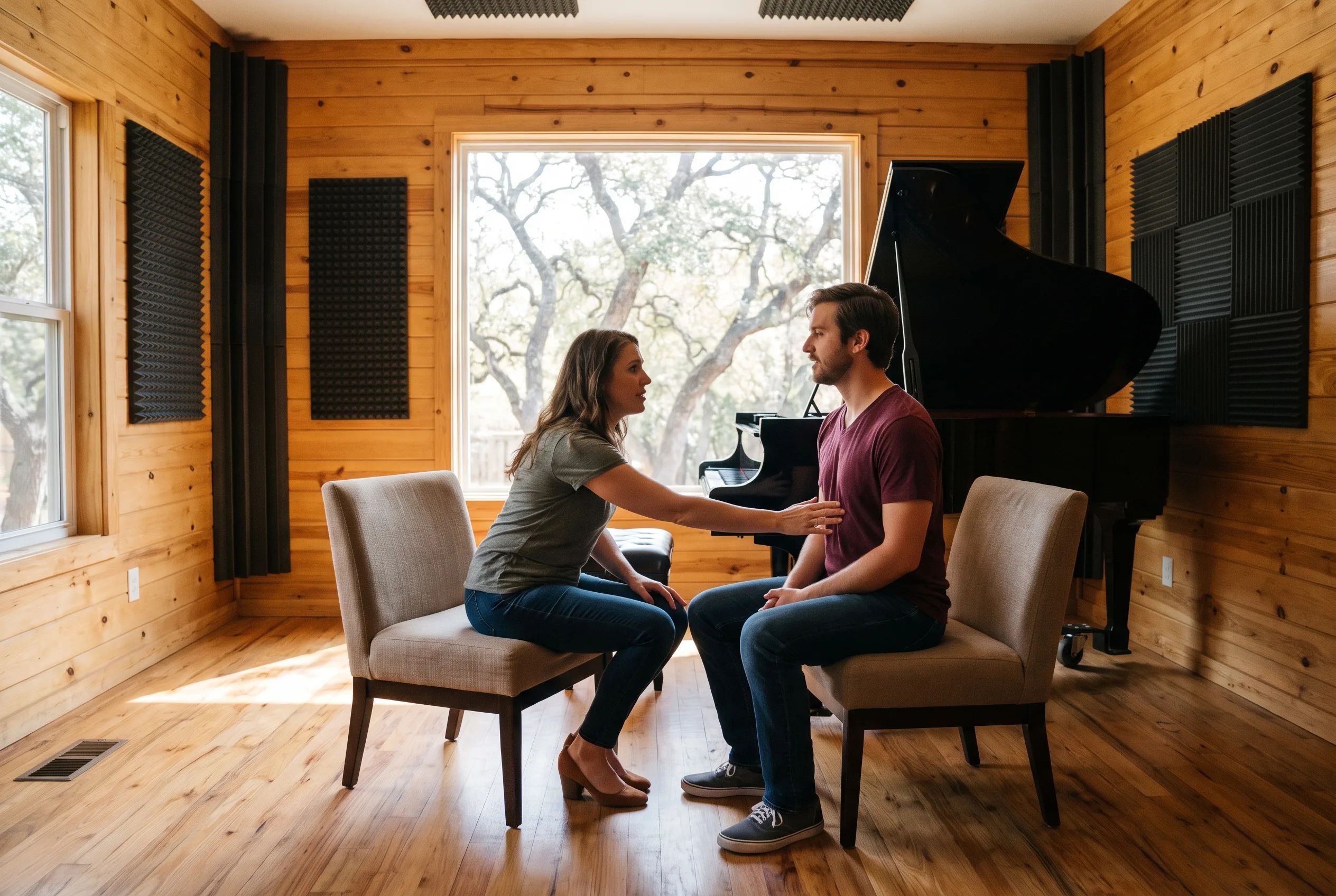
What Private Voice Lessons in Austin Include
A private lesson is the only format where the instruction can be wrong for everyone except you. That is the point. In a group class the teacher has to give advice that is safe for the whole room, which means it is rarely the specific correction any one singer needs. One to one, the correction can be exact.
Every private lesson covers four areas, weighted according to what your voice currently needs:
- Breath management. Not "take a bigger breath", but controlling the exhale so air is not wasted in the first two seconds of a phrase. Most students already inhale plenty.
- Vocal fold coordination. How efficiently the folds come together. Too pressed and the voice tires and sounds strained. Too breathy and it lacks carrying power and also tires, for a different reason.
- Resonance and vowel shaping. The tract above the larynx acts as a filter. Changing its shape changes tone dramatically without changing effort, which is where most of the "bigger sound with less work" gains live.
- Register coordination. Blending chest and head function so the transitions stop being audible events.
Repertoire sits on top of that technical work. Songs are chosen to expose the thing you are training, so practice and performance material reinforce each other rather than competing for time.
Signs You Would Benefit From Private Lessons
Some people arrive with a clear goal. Many arrive with a symptom and no idea what causes it. These are the most common signals that one to one work is the right format:
- Your voice works fine up to a certain note, then thins, cracks, or vanishes
- You are hoarse or tired after singing, speaking at length, or teaching a full day
- You have been self teaching from videos for a year or more and have plateaued
- You sound good in a lesson or a shower and noticeably worse on stage or on a recording
- You have taken group classes and never got a correction that felt aimed at you
- You can hear that a note is wrong but cannot reliably steer your voice to the right one
The National Institute on Deafness and Other Communication Disorders estimates about 7.5 million people in the United States have trouble using their voices. A large share of those cases are not disease, they are technique, and technique is trainable.
Our Process
Diagnostic first session
We map your comfortable range, your full range, and the gap between them. We listen to your speaking voice, because habits there usually appear in the singing voice too. Then we find the exact point where the voice stops doing what you ask, and identify which of breath, tension, or register coordination is responsible.
Targeted exercise prescription
You get a small number of exercises chosen for your specific cause, not a standard warm up sequence. Each one comes with an explanation of what it targets and the sensation to listen for, so you can tell whether you are doing it correctly when nobody is watching.
Weekly work and adjustment
Each lesson opens by checking what happened during the week. Exercises that produced change are kept and progressed. Exercises that did not are replaced rather than repeated harder, which is the usual failure mode of self directed practice.
Repertoire application
Technique that only works in exercises is not yet technique. We apply each gain to real songs or real speaking material, under progressively more realistic conditions, until it survives contact with performance.
Independence
The goal is a student who can diagnose and correct their own voice. Most people reach a point where lessons shift from weekly to occasional maintenance, and that is a successful outcome rather than a lost customer.
Lesson Format Options Compared
| Format | Best for | Trade offs |
|---|---|---|
| 60 minute, in person, weekly | Adults working on technique and repertoire together, performers with a gig schedule | Requires travel time. Highest rate per session but the most work covered. |
| 45 minute, in person, weekly | Younger students, beginners, anyone whose voice tires inside an hour | Less repertoire time. A tired voice stops learning, so longer is not always better. |
| 60 minute, online, weekly | Students outside the in person service area, busy schedules, bad weather backup | Needs wired headphones and a stable connection. Fine detail in very quiet singing is harder to assess. |
| Twice weekly, any length | Audition or recording deadlines inside the next four to six weeks | Highest cost per month. Only worth it when a fixed date is driving the work. |
| Every other week | Maintenance for students with established technique and reliable practice habits | Too slow for beginners, since errors get two weeks to consolidate before correction. |
If you are unsure, start with weekly 60 minute lessons and adjust after a month. Most students settle into the right format quickly once they see how their own voice responds.
What Affects the Cost of Private Voice Lessons
- Lesson length. The main driver. A 60 minute lesson generally costs proportionally more than a 45.
- Frequency and packages. Blocks booked in advance usually carry a lower per lesson rate than single sessions.
- In person versus online. Online lessons remove travel overhead on both sides and are often priced accordingly.
- Travel within the service area. Lessons requiring travel to outlying communities may carry a different rate than a central Austin session.
- Specialisation. Deadline driven audition or recording preparation is more intensive than open ended technique work.
Ask for the current rate card when you enquire. Any coach who cannot give you a straight answer about pricing before you book is worth being cautious about.
Why Austin Voices Have Specific Demands
Austin has been the officially designated Live Music Capital of the World since the City Council adopted the title in 1991, and that shapes what local singers actually need from private lessons. A singer here is far more likely to be performing multiple sets in a loud room than delivering one recital a season. That changes the priorities: efficiency and stamina matter more than maximum volume, and a warm up has to work backstage in five minutes rather than in a quiet studio over thirty. Central Texas allergy seasons add another variable, since congestion changes resonance and tempts singers to push harder to compensate, which is exactly when injuries happen.
Why students choose us
Why Choose Voice Coach Austin for Private Lessons
Explanations You Can Verify
Roughly 30 percent of adults experience a voice disorder at some point, according to population research published in The Laryngoscope, and vague instruction is part of why. Every exercise you are given comes with the physical reason it works and the sensation to check for. If a correction does not make sense to you, ask, and you will get an anatomical answer rather than a metaphor.
Nothing Off the Shelf
Two students with identical symptoms frequently need opposite corrections, because one is over pressing and the other is under closing. A standard curriculum cannot tell them apart. Diagnosis before prescription is the single biggest reason private lessons outperform group classes and video courses, and it is the core of how lessons run here.
The Week Between Lessons Counts
You spend one hour with a coach and six days without one, so the written practice plan is not an afterthought. Motor learning research consistently shows distributed practice outperforms one long session, so plans are built around short daily work. Every plan names the exercise, its purpose, and what correct execution should feel like.
Frequently Asked Questions
How long is a private voice lesson?
Most students take a 45 or 60 minute lesson. Sixty minutes suits singers working on repertoire alongside technique. Forty five minutes is often better for younger students and for anyone whose voice tires quickly, since a fatigued voice stops learning and starts compensating.
Do I need to read music to take private voice lessons?
No. Most students who come to us do not read music, and plenty of working singers never learn. Lessons use listening, imitation, and physical sensation as the primary teaching tools. If you want to learn to read music we can add it, but it is never a prerequisite.
How often should I take private lessons?
Weekly works best for most students. The gap is long enough to practise properly and short enough that errors do not become habits. Students preparing for a fixed date sometimes move to twice weekly, and singers maintaining an established technique can drop to every other week.
What should I bring to my first lesson?
Water, comfortable clothing that does not restrict your ribs or waist, and one or two songs you like singing, in any style. Recordings or backing tracks on your phone are useful. You do not need sheet music and you do not need to prepare anything.
Can private voice lessons help my speaking voice, not just singing?
Yes. The speaking and singing voice use the same instrument, so breath management, resonance, and tension work transfer directly. Teachers, attorneys, podcasters, and presenters make up a meaningful share of private students and often work entirely on speech.
What happens in the first private voice lesson?
The first session is diagnostic. We listen to your speaking voice, map your comfortable and full range, test breath management, and find where the voice stops doing what you ask. You leave with a written practice plan naming each exercise and the reason it is on your list.
Related Services
If you are brand new to singing, singing lessons for beginners is the gentler entry point. Experienced singers working on stamina and register control should look at vocal coaching for advanced singers. If travel is the obstacle, online voice lessons cover the same ground by video. You can also read more about our teaching approach or get in touch.
Ready when you are
Book Your First Private Voice Lesson
Leave the first session knowing what is limiting your voice and exactly what to practise next.
Book Your First Lesson Call (512) 555-0142