Austin, Texas
Group Singing Classes and Workshops in Austin
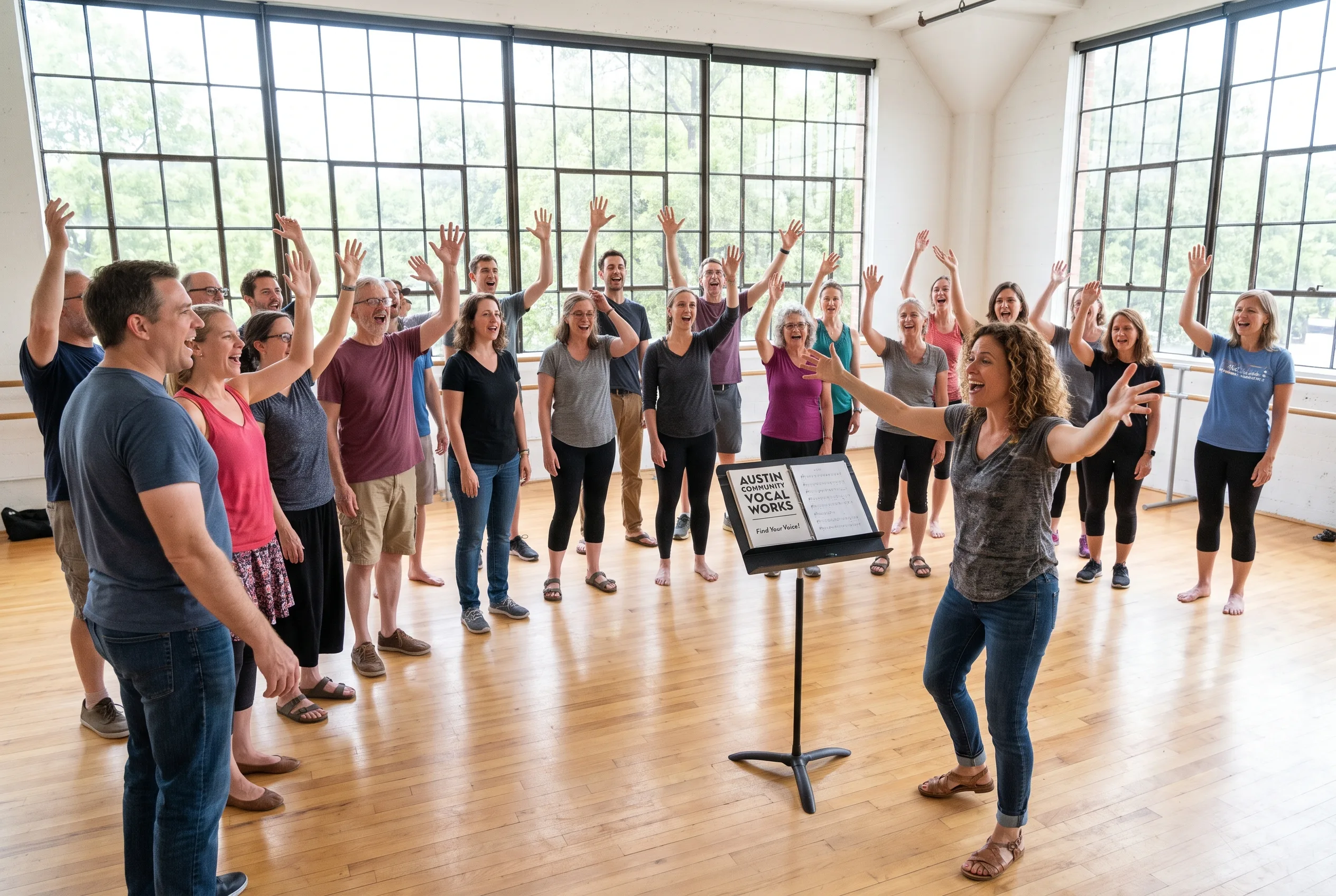
Group singing classes in Austin do something private lessons cannot: they teach you to sing with other people, in front of other people. That is a separate skill from singing well, and plenty of technically capable singers do not have it.
- Lower cost entry point than private lessons
- Harmony and ear training you cannot practise alone
- Performance exposure in a low stakes room
- Workshops on single topics for focused work
Ask About Group Classes
Tell us what you want to work on. We reply within one business day.
What Group Classes Cover
Group work is not a cheaper substitute for private lessons. It teaches genuinely different skills, and the two formats complement each other rather than competing. What a group provides that a private lesson structurally cannot:
- Harmony singing. Holding your own line while other parts move around you is impossible to practise alone in any realistic way.
- Blend and listening. Adjusting your own tone and volume in response to what you hear around you, in real time.
- Performance exposure. Regular, low stakes practice at singing while other people are listening, which is the only reliable way to reduce performance nerves.
- Ear training in context. Recognising intervals and harmonic movement while actively singing, rather than in isolated exercises.
- Repertoire volume. Groups cover more material more quickly than one to one work typically does.
Who Group Classes Suit
- Beginners who want to start singing without the intensity of one to one attention
- Singers who are technically fine alone and fall apart in front of an audience
- Anyone who wants to sing harmony but has only ever sung melody
- People returning to singing after years away and wanting a gentle restart
- Private students wanting extra repetitions and performance practice between lessons
- Anyone who finds solo lessons intimidating as a first step
Workshops Versus Ongoing Classes
| Format | What it is | Best for |
|---|---|---|
| Ongoing weekly class | A consistent group meeting regularly, building repertoire and skills over a term | Steady progress, building confidence gradually, and the social side of singing. |
| Single topic workshop | A one off session on a focused subject such as harmony, belt safety, or microphone technique | Filling a specific gap without committing to a term. |
| Performance workshop | Structured practice at performing for the rest of the group, with feedback | Singers whose technique is ahead of their nerves. |
| Beginner group course | A short course covering fundamentals from zero, with others at the same stage | Total beginners who want company while starting out. |
| Private lessons plus group | Technical correction one to one, plus group repetition and exposure | The combination that produces the fastest progress for most students. |
The Honest Limitation of Group Work
Worth saying plainly: a group teacher must give instruction that is safe for everyone in the room, which means it is rarely the specific correction any individual singer needs. Two singers with an identical symptom often need opposite fixes, because one is pressing too hard and the other is not closing enough, and a group setting cannot separate them. It is also easy to hide inside a group, singing quietly enough that nobody, including you, finds out what your voice actually does.
That is why the recommendation for most people is not group instead of private, it is group alongside private, or group first and private once you know you want to continue. Anyone who tells you a group class alone will fix a specific technical problem is overselling it.
How Classes Run
Shared warm up
The group warms up together, which doubles as instruction, since the exercises themselves teach breath management and onset quality.
Skill focus
A defined topic for the session, such as holding a harmony line, matching vowels across a group, or dynamic control.
Repertoire
Applying the skill to actual songs, usually in parts, so the learning is immediately contextual rather than abstract.
Performance practice
Opportunities to sing in smaller groupings or individually for the room, entirely optional and built up gradually.
Take home work
Parts and practice notes so people arrive next time having done the individual work, which is what keeps a group moving.
What Affects Group Class Pricing
- Group size. Smaller groups cost more per person and give more individual attention.
- Term length. Multi week courses generally carry a lower per session rate than drop in attendance.
- Workshop format. One off intensive workshops are priced separately from ongoing classes.
- Materials. Sessions requiring arranged parts or licensed material may carry a small additional cost.
Group Singing in Austin
Austin has an unusually strong culture of communal singing for a city of its size, running from church and gospel traditions through community choirs, songwriter circles, and the open mic scene that the Live Music Capital designation has sustained since 1991. That matters for a group class because there is somewhere to take the skills afterwards. Harmony singing in particular is directly useful here: the local scene has a deep bench of Americana, country, folk, and gospel influenced music where backing vocals and close harmony are standard rather than decorative, and singers who can hold a harmony line reliably find themselves invited onto other people's projects. Group classes are one of the more practical routes into that, alongside being a genuinely low pressure way to start.
Why students choose us
Why Singers Choose Our Group Classes
Skills You Cannot Practise Alone
Holding your own line while other parts move around you, blending tone with people either side of you, and adjusting volume in real time are all skills that require other singers in the room. No amount of private practice develops them. In a scene rich in Americana, country, folk, and gospel, reliable harmony singing also opens doors onto other people's projects.
Performance Exposure Without the Stakes
Performance nerves reduce through exposure rather than through additional practice at home. A group class provides regular, low consequence repetitions of singing while other people listen, built up gradually and always optional. For singers whose technique is well ahead of their nerves, this is usually the missing piece rather than more technical work.
Straight Advice About the Limits
Group instruction has to be safe for everyone present, so it is rarely the exact correction any individual needs, and it is easy to hide inside a group. We say so. For most people the right answer is group alongside private lessons, or group first and private once you know you want to continue, rather than group as a cheaper replacement.
Frequently Asked Questions
Do I need experience to join a group singing class?
No. Classes are grouped by level and beginner focused courses assume no experience at all. Many people find a group a less intimidating starting point than a one to one lesson, because nobody is listening to them individually.
Will I have to sing on my own in front of the group?
Only if you choose to. Solo singing within the class is optional and built up gradually. Plenty of people attend for a full term singing only as part of the group, and that is a completely normal way to participate.
Are group classes as good as private lessons?
They are good at different things. Groups teach harmony, blend, listening, and performance exposure, which private lessons structurally cannot. Private lessons give corrections aimed precisely at your voice, which groups cannot. Most people progress fastest doing both.
Can I learn harmony in a group class?
Yes, and it is one of the main reasons to attend. Harmony requires other people singing different lines simultaneously, so it is close to impossible to develop properly on your own regardless of how much you practise.
How big are the groups?
Small enough that individual voices can still be heard and given some attention. Group size directly affects both the per person cost and how much individual feedback is possible, so we keep it in a range where the class still works as teaching.
What is the difference between a class and a workshop?
A class runs weekly over a term and builds skills and repertoire progressively. A workshop is a single session on one focused topic, such as harmony or microphone technique, and is useful for filling a specific gap without committing to a term.
Related Services
Most people pair group work with private voice lessons, since the two formats teach different things. Complete beginners may prefer starting with singing lessons for beginners. If nerves are the main obstacle, see audition prep and performance coaching, which treats performance anxiety as physiology rather than a pep talk.
Ready when you are
Ask About Group Classes and Workshops
Tell us your level and what you want out of it, and we will point you at the right format.
Book Your First Lesson Call (512) 555-0142