Austin, Texas
Voiceover and Broadcast Voice Coaching in Austin
Voiceover coaching in Austin covers a different skill set from singing. The microphone is unforgiving, the reads are specific, and the endurance demands of a long session catch out people who have never trained their speaking voice.
- Microphone technique and distance control
- Commercial, narration, e-learning, and character reads
- Vocal endurance for long recording sessions
- Home studio guidance that does not require a big budget
Book Voiceover Coaching
Tell us what you want to work on. We reply within one business day.
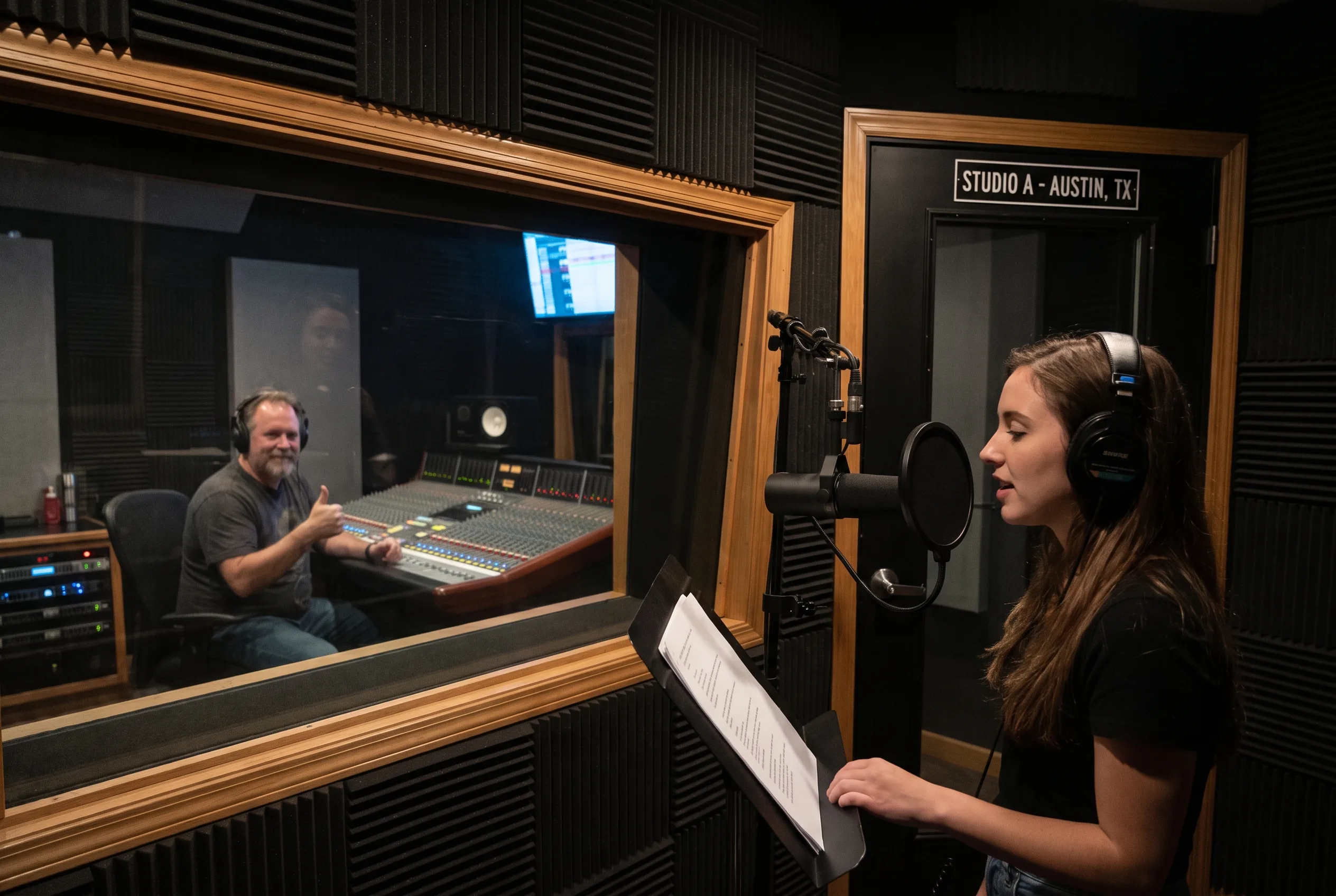
What Voiceover Coaching Covers
Voiceover is speaking, recorded closely, with intent. Each of those three elements needs training, and the people who struggle usually have one of them handled and assume the others follow automatically. Actors often have intent but not microphone control. Broadcasters often have both but a limited stylistic range. Singers often have breath control and no idea how to be conversational.
- Microphone technique. Distance, angle, and how to move on loud syllables. Proximity effect, plosives, and sibilance are all managed by position before they are managed by equipment.
- Read styles. Commercial, corporate narration, e-learning, audiobook, character, and promo each have distinct conventions in pace, warmth, and energy.
- Script interpretation. Finding the operative word in a line, deciding what the read is actually selling, and delivering it without sounding like it is being read.
- Vocal endurance. Sustaining consistent quality through a long session, which is where untrained voices audibly degrade.
- Consistency across takes. Matching energy and tone so edits are invisible, including on pickups recorded days later.
Signs You Need Voiceover Coaching
- Your recordings sound like someone reading rather than someone talking
- You are hoarse or flat by the end of a long recording session
- Your plosives pop and your sibilance is harsh regardless of what you buy
- You can do one read style and everything you record sounds the same
- Your pickup takes never match the original session
- You are a podcaster whose voice tires within an hour of recording
The Speaking Voice Is a Trainable Instrument
Occupational voice users carry substantially elevated risk of voice problems, and the evidence on this is strong. Research by Roy and colleagues found teachers reported a lifetime prevalence of voice problems of roughly 58 percent, against about 29 percent among non teachers. Voice actors, podcasters, and broadcasters sit in the same category of heavy professional voice use, frequently with less awareness of technique than a trained singer would have and often recording for several hours at a stretch. The underlying mechanics are identical to singing: breath management, efficient vocal fold closure, and released jaw and tongue tension. What differs is application, and applying it to speech is the entire discipline.
Read Styles Compared
| Read style | Character of the delivery | Main technical demand |
|---|---|---|
| Commercial | Conversational, warm, energised without sounding pushed | Sounding spontaneous while hitting an exact time. Hardest to fake. |
| Corporate narration | Clear, measured, authoritative, neutral | Sustaining interest across long copy without becoming monotone. |
| E-learning | Friendly, clear, patient, consistently paced | Extreme consistency across many modules recorded on different days. |
| Audiobook | Sustained, intimate, character differentiated | Endurance above all. Hours of recording with stable tone and energy. |
| Character and animation | Broad, physical, often extreme | Vocal safety. Character work is where untrained voices get injured fastest. |
| Promo and trailer | High energy, driving, punchy | Power without pressed onset, which is difficult to sustain across takes. |
How Coaching Runs
Assess the speaking voice
We look at your habitual speaking pitch, breath pattern, and any tension carried in the jaw, tongue, or neck. Most voiceover problems originate in ordinary speech habits rather than in performance choices.
Fix the microphone relationship
Position, distance, and angle, plus how to move to control plosives and sibilance. This solves problems people usually try to solve by buying equipment.
Build read range
Working systematically through styles so you have more than one gear, using real copy rather than exercises.
Train endurance
Progressively longer sessions with attention to efficiency, hydration, and recovery, so quality at hour three matches hour one.
Session readiness
Direction taking, self direction when recording alone, slate conventions, and matching pickups to earlier takes.
What Affects Pricing
- Scope. Fixing microphone technique is a short project. Building range across multiple read styles is ongoing.
- Session length. Endurance work requires longer sessions by definition.
- Demo preparation. Producing a demo reel involves script selection, coaching, and multiple recorded takes.
- Frequency. Intensive preparation before a specific booking differs from ongoing development.
Voice Work in the Austin Market
Austin supports a broader voice market than many people realise, and its shape is worth understanding if you are building a career here. The city is an established film and television production hub, which generates periodic character and commercial work, and it has a large technology and corporate sector producing steady demand for e-learning, explainer, and internal communications narration. That corporate and e-learning stream is less glamorous than character work but far more consistent, and it rewards exactly the qualities coaching can build: clarity, patience, and consistency across modules recorded weeks apart. Podcasting adds another layer, with Edison Research's Infinite Dial studies tracking monthly podcast listening well above 40 percent of Americans aged 12 and over in recent years, and a great many local hosts recording for hours weekly with no vocal training at all.
Why students choose us
Why Voice Professionals Choose Voice Coach Austin
Heavy Speaking Voices Get Trained Properly
Roy and colleagues found teachers reported voice problems at a lifetime rate near 58 percent against roughly 29 percent for non teachers, and voice actors, podcasters, and broadcasters sit in that same heavy use category with less technical awareness. Coaching applies the same breath management and efficient closure a singer trains, aimed specifically at speech and at multi hour sessions.
Technique Before Equipment
Plosives, sibilance, and inconsistent tone are managed by distance and angle long before they are managed by a microphone purchase. Most people arriving with these problems have been trying to buy a solution. Fixing the relationship with the microphone is usually a short project and it resolves complaints that gear upgrades never did.
More Than One Gear
Commercial, corporate narration, e-learning, audiobook, character, and promo each carry distinct conventions in pace, warmth, and energy. A performer with one read style is restricted to a narrow slice of available work. In a market where corporate and e-learning demand is the steadiest stream, range is directly commercial rather than merely artistic.
Frequently Asked Questions
Do I need singing experience for voiceover coaching?
No. Voiceover is a speaking discipline. Singing experience helps with breath management, but many excellent voice actors have never trained as singers, and singers often have to unlearn a performance quality that reads as unnatural on microphone.
Why do my recordings sound like I am reading?
Usually because the delivery is following punctuation rather than meaning. The fix is script interpretation work: identifying the operative word in each line and deciding what the read is actually communicating, then delivering that rather than the text.
Can you help with plosives and sibilance?
Yes, and it is usually a positioning problem rather than an equipment problem. Distance, angle, and learning to move slightly on loud syllables solve most of it. People commonly try to buy their way out of this and stay frustrated.
My voice gets tired during long recording sessions. Is that fixable?
Yes. Endurance is primarily about efficiency per phrase rather than strength, so the work involves reducing effort, releasing tension, and managing recovery. Progressive session length training then builds tolerance on top of the more efficient technique.
Do I need an expensive home studio?
No. Room treatment and microphone positioning matter considerably more than the price of the microphone. Coaching includes practical guidance on getting a usable recording space without a large budget.
Do you coach podcasters as well as voice actors?
Yes. Podcast hosts often record for hours weekly with no vocal training, which is a classic heavy use pattern. Endurance, consistency, and reducing tension are the usual priorities, alongside basic microphone technique.
Related Services
Voiceover students frequently also work on private voice lessons for underlying breath and tension work, and on advanced vocal coaching when endurance across long sessions is the priority. This service works particularly well as online voice lessons, since it is microphone based already.
Ready when you are
Book Voiceover Coaching
Bring a script and your current setup, and we will find what is between you and a usable take.
Book Your First Lesson Call (512) 555-0142