Austin, Texas
Singing Lessons for Beginners in Austin
Singing lessons for beginners in Austin should start by proving to you that you can sing, because most people who think they cannot are wrong about that. No audition, no experience, and no music reading required.
- Absolute beginners welcome, including self described tone deaf
- No audition and no prepared material needed
- Private lessons, so nobody else hears you learning
- Adults and teens, any musical style you like
Book a Beginner Lesson
Tell us what you want to work on. We reply within one business day.
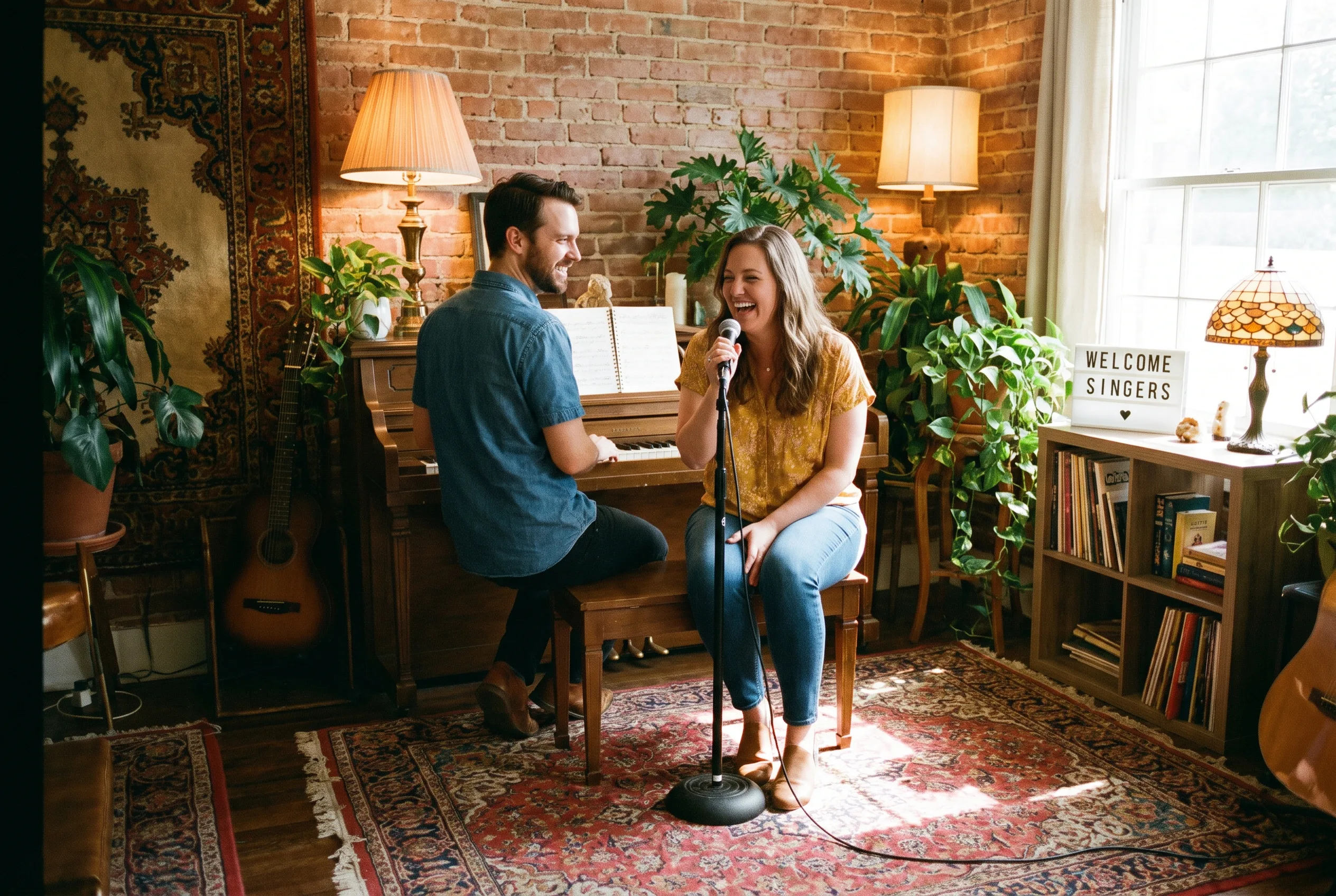
What Beginner Singing Lessons Include
Beginner lessons in Austin start further back than most people expect, and that is deliberate. Before any song, the first job is to get the instrument out of its own way. Almost every new singer arrives carrying three habits that have nothing to do with musical talent: a collapsed posture that limits rib movement, a jaw and tongue that grip on every vowel, and a breathing pattern built for talking rather than sustaining.
The early curriculum covers:
- Posture and alignment. Where the ribs, head, and shoulders need to be so the breath mechanism can actually move.
- Breath, in the useful sense. Learning to release air slowly and evenly, which is the actual skill, rather than learning to inhale more.
- Pitch matching. Hearing a target note and steering your voice onto it, first with simple slides and then with intervals.
- Releasing tension. Unlocking the jaw, tongue, and neck, which alone changes most beginners' tone noticeably inside a few weeks.
- Your first repertoire. One or two songs you actually like, chosen to sit comfortably in your current range rather than to stretch it.
You will sing in the first lesson. Not scales for a month first.
Signs Beginner Lessons Are the Right Starting Point
- You have never had a singing lesson and would not know where to start
- You have been told, or have decided, that you are tone deaf
- You only sing in the car or the shower and go quiet if anyone can hear
- You can hear when you are off pitch but cannot fix it
- You sing in a choir or a congregation and want to stop hiding inside the group
- You have tried learning from videos and cannot tell whether you are doing it right
That last one matters more than people realise. The core problem with self teaching is not the quality of the information, it is the absence of feedback. You cannot hear your own voice the way a listener does, because you hear it partly through bone conduction inside your own skull. A coach hears what the room hears.
About "I'm Tone Deaf"
Almost nobody who says this is describing a real condition. Congenital amusia, the genuine neurological inability to process pitch relationships, is estimated to affect roughly 4 percent of the population. The other 96 percent of people who believe they are tone deaf are describing something completely different and entirely fixable: an untrained ear paired with an untrained set of muscles. They can often hear perfectly well that a note is wrong, which is itself proof the pitch processing works, and simply have no trained control over the mechanism that would correct it.
Your First Ninety Days
Weeks one to two, establish a baseline
We find your current comfortable range, check pitch matching accuracy, and identify the biggest single obstacle. Most beginners have one dominant problem rather than five small ones, and naming it early prevents months of unfocused work.
Weeks three to six, release before build
Tension work and breath release come first. This is the stage where most beginners report the biggest surprise, because removing interference usually reveals more voice than they knew they had. No strength building yet.
Weeks six to ten, coordination
Pitch accuracy drills, simple intervals, and sustained tone. The ear and the muscles get trained together, since training either one alone produces a singer who knows they are wrong but cannot fix it, or one who is stable but inaccurate.
Weeks ten to twelve, apply it to a song
A full song, start to finish, at a standard you are happy to let someone hear. Getting one song genuinely solid teaches more than half learning six.
Most beginners notice a real change in tone and breath control somewhere in the first four to six lessons, because those early gains come from releasing tension rather than from building new strength. Range and stamina take considerably longer, since they depend on conditioning small muscles, and that follows the same slow timeline as any other physical training.
Beginner Learning Formats Compared
| Format | Strengths | Limitations |
|---|---|---|
| Private beginner lessons | Feedback aimed exactly at your voice. Nobody else hears you learning. Fastest correction of the specific habit holding you back. | Higher cost per hour than group formats. |
| Group singing class | Lower cost, social, good for confidence and for singing in front of others. | Corrections must be safe for everyone, so they are rarely aimed at you. Easy to hide and stay stuck. |
| Online video courses | Cheap, self paced, and useful as a supplement. | No feedback loop at all. You cannot hear yourself the way a listener does, so errors go uncorrected for months. |
| Choir or congregation singing | Free or low cost, regular practice, good ear training by immersion. | Designed for blending, not for developing an individual voice. Bad habits are invisible inside a group. |
| Private lessons plus a choir | The combination most beginners do best with: technical correction weekly, plus low pressure repetition. | Requires more time commitment across the week. |
What Affects Beginner Lesson Pricing
- Lesson length. Many beginners start at 45 minutes rather than 60, because an untrained voice fatigues sooner and a tired voice stops learning.
- Package versus single lessons. Blocks booked in advance normally carry a lower per lesson rate.
- Frequency. Weekly is standard. Every other week costs less per month but slows progress noticeably at the beginner stage, when habits form fast.
- In person or online. Online removes travel for both sides and is often priced differently.
Beginners rarely need long or intensive packages at the start. A month of weekly lessons is usually enough to tell whether you enjoy the process.
Starting Out as a Singer in Austin
Beginning in Austin has one genuine advantage over almost anywhere else in Texas. The city has been the officially designated Live Music Capital of the World since 1991, and the practical consequence for a nervous beginner is an unusually deep supply of low stakes places to sing in public: open mics, songwriter nights, and small rooms where nobody expects a polished set. Getting stage repetitions early matters, because performance nerves are trained down by exposure rather than by extra practice at home. The flip side is that Austin's music scene can be intimidating precisely because the standard around you is high, so beginner lessons here spend more time than usual on managing comparison.
Why students choose us
Why Beginners Choose Voice Coach Austin
We Will Not Tell You That You Cannot Sing
True congenital amusia affects an estimated 4 percent of the population, so the overwhelming likelihood is that your voice is trainable and simply untrained. Beginners here are assessed on what their voice does now and what is blocking it, never on whether they have a gift. In practice, beginners often progress fastest of anyone, because there are fewer years of entrenched compensation to unpick.
Early Wins Come From Release, Not Strength
Most beginners notice a real change in tone and breath control within four to six lessons. That is not a sales claim, it is a consequence of where the early gains come from: unlocking a gripped jaw and a collapsed posture reveals voice that was already there. Strength and range come later and slower, and we say so up front rather than promising fast results everywhere.
No Audition and No Prerequisites
There is no entry standard, no audition, no requirement to read music, and no expectation that you arrive with prepared material. Most beginner students cannot read music and never need to. Bring a song you like on your phone. Nerves about a first lesson are so common that they are effectively the default, and the first session is structured around that.
Frequently Asked Questions
I think I am tone deaf. Can I still take singing lessons?
Almost certainly yes. Congenital amusia, the genuine inability to process pitch, is estimated to affect around 4 percent of people. Most who describe themselves as tone deaf can hear that a note is wrong, which proves the pitch processing works, and simply lack trained control over the muscles that would correct it.
Do I need any experience to start beginner singing lessons?
None. No audition, no music reading, no prepared song, and no prior lessons. The majority of beginner students have never had a lesson and many have never sung in front of another person. The first session is built around that being normal.
Am I too old to start singing lessons?
No. Adults learn voice well, and in some respects better than children, because they can understand and apply an explanation about breath or resonance immediately. Voices change with age but remain trainable throughout adult life.
Will I have to sing in front of other people?
Not unless you want to. Beginner lessons are private, so the only person hearing you learn is your coach. If performing is one of your goals we build up to it gradually, and if it is not, that is a perfectly normal reason to take lessons.
How long before I sound better?
Most beginners notice changes in tone and breath control within four to six lessons, because early progress comes from releasing tension rather than building strength. Range extension and stamina take months, since they depend on conditioning small muscles.
What style of music will I sing?
Whatever you actually like. Technique is largely style neutral at the beginner stage, so there is no reason to work through classical repertoire unless that is what you want to sing. Bring pop, country, rock, gospel, musical theatre, or anything else.
Related Services
Once the fundamentals are steady, most beginners move into private voice lessons for ongoing technical work. If you would rather start alongside other people, group singing classes and workshops are a lower pressure option. Outside the in person area, online voice lessons work well for beginners. For students under 18, see kids and teens voice lessons, or get in touch to ask which fits.
Ready when you are
Book Your First Singing Lesson
No audition, no experience, and no expectation that you already sound good. Just a starting point and a plan.
Book Your First Lesson Call (512) 555-0142